



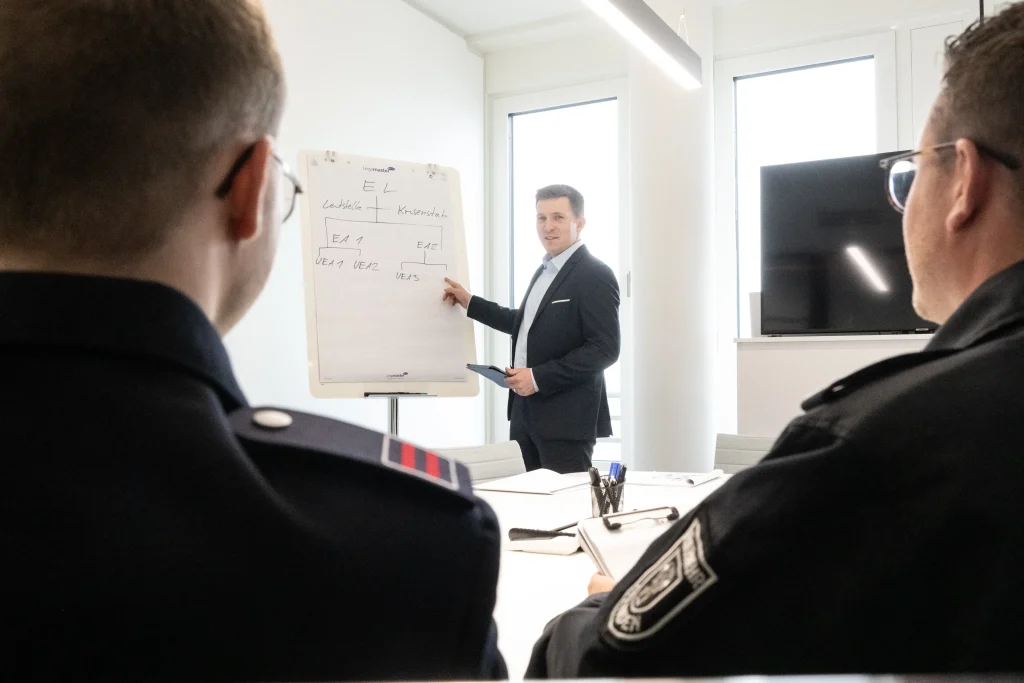
Leadership in day-to-day station operations
Leadership Training for Daily Watch Operations
Leadership in daily watch operations is a complex field of responsibility. In this two-day seminar, we train you in all relevant aspects of leadership competencies. Throughout the event, theoretical and practical components are expertly combined.
First, individual topics are presented and explained with particular focus on the situation in emergency services (fire departments, emergency medical services, etc.). You will learn about the multifaceted nature of these topics and have the opportunity to contribute your own examples from daily watch operations. This is particularly valuable. We then build upon this with the latest insights from employee leadership and communication techniques. Sufficient time is available for personal reflection on your role as a leader.
Some of the aspects covered in this two-day seminar:
- How do I deal with difficult framework conditions?
- How do I conduct a conflict resolution conversation?
- How do I properly praise my employees?
- What can I do as a leader in the classic sandwich position?
The seminar provides a solid foundation based on theoretical knowledge, delivers numerous practical insights, and offers ample opportunity to practice. The goal of the event is to arrive at a confident personal leadership style by the end of the two days. The seminar is led by an experienced leader in the field.
Request a date via the seminar office
Watch commanders, watch division leaders, shift supervisors, watch division managers
Learning Objectives:
Establishing a personal leadership style
Period & Location:
In-house event at your premises or as an open seminar
Course Program:
Day 1
- Types, objectives, and functions of leadership
- Leadership styles
- In-depth exploration of the situational leadership approach
- The role of the leader
Key insight: There is no single correct leadership style! - Personality assessment and reflection
Day 2
- Introduction to communication techniques
- Communication model
- The invisible foundation of a conversation
- Non-verbal communication
- Why listening is so important
- Assessment of personal communication behavior and reflection
- Guidance and questioning techniques
- Conversation guidelines
- The nature of conflict and why conflicts are normal
- Approaches to conflict resolution