Whether due to the pandemic, floods, or power outages: crisis management in municipalities has been repeatedly challenged in diverse ways in recent years.
Between comprehensive municipal emergency response, e.g., by the fire department, and civil protection (often organized at the district level), gaps in planning and preparedness become evident, especially in acute stress situations. This makes it all the more important to critically analyze who is currently performing which tasks. The goal is to identify potential needs for action and derive recommendations for closing capability gaps.
In the event of a crisis—regardless of its nature—other operational or administrative structures and organizations are always affected and involved in the response alongside traditional emergency services. However, as processes become more complex, the susceptibility to hazards—so-called vulnerability—also continues to increase.
This means that comprehensive municipal, administrative, and operational crisis management, adapted to specific risks, is of crucial importance.
We support you in all matters of crisis prevention, risk analysis, requirements planning, and the conceptual design of crisis preparedness.
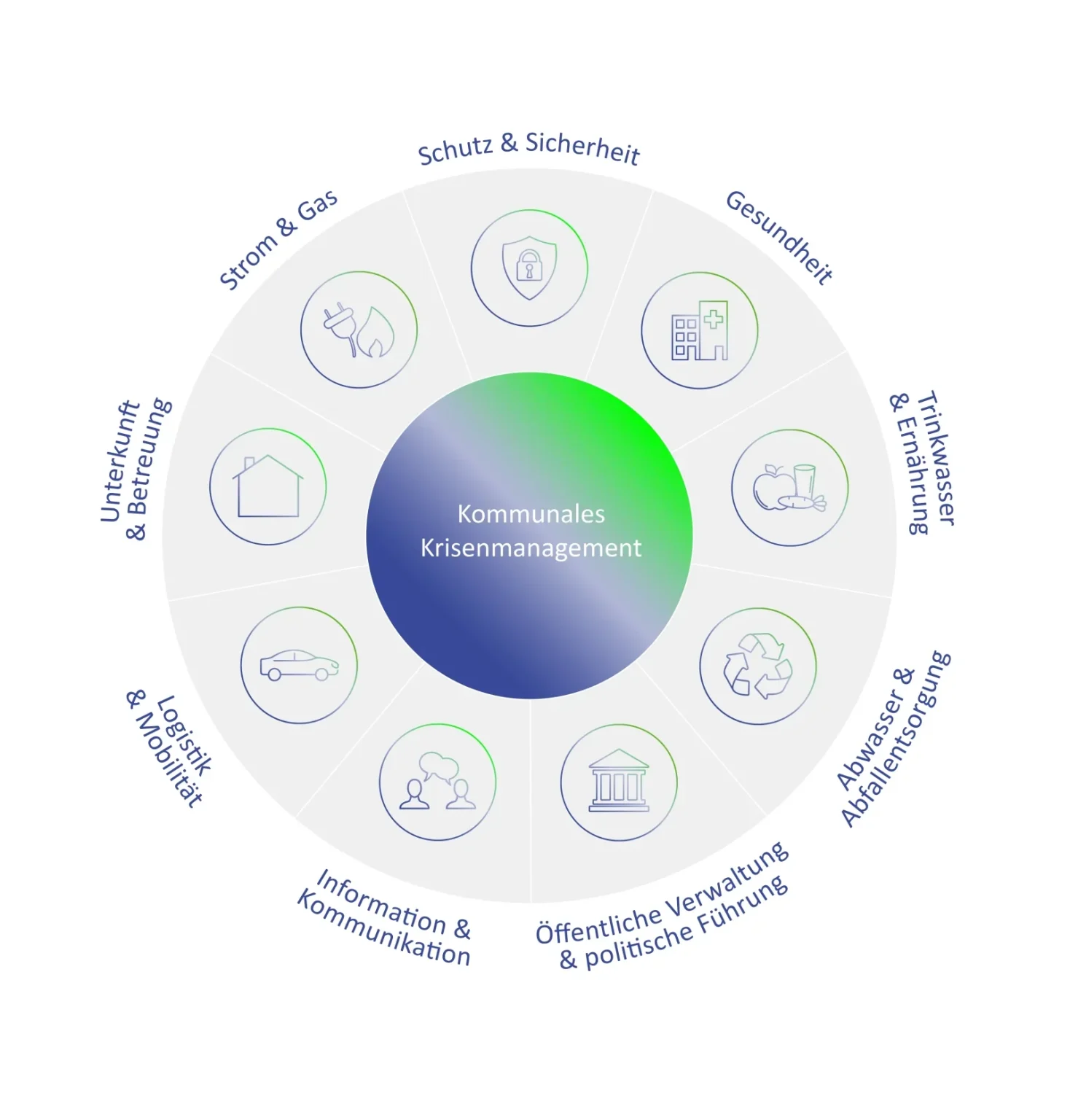
The illustration is a pie chart. In the center is a circle labeled “Municipal Crisis Management”. Eight sectors are arranged in a ring around it, each with an icon and label. They represent the critical supply and task areas that municipal crisis management must cover:
– Protection & Security – Health – Drinking Water & Food – Wastewater & Waste Disposal – Public Administration & Political Leadership – Information & Communication – Logistics & Mobility – Accommodation & Care – Electricity & Gas
The representation illustrates that municipal crisis management, as a cross-sectional task, must take all these critical sectors into account equally.
Diverse measures.
Four core areas.
Municipal crisis management includes a variety of different (prevention) measures. KRISEN+ bundles these into four core areas:
Emergency Response
Establishing resilient crisis planning for this important pillar of municipal crisis management is extremely important. Our experience shows that the impact on emergency response is not always consistently thought through to the end. Many assumptions turn out to be “too optimistic” in the event of a crisis.
Infrastructure
A key task is to ensure the functionality of critical infrastructure and emergency response buildings (e.g., emergency power supply) at all times.
Communication
Maintaining communication options is also a major challenge, the organization of which must not begin only when a crisis occurs.
Maintenance of Operations
In short-term crises, the focus is on elementary core tasks and the pure maintenance of operations. In longer-term crises, it must also be possible to maintain other processes.
What we provide.
How you benefit.
Continuous needs planning and implementation support through “Needs Plan 365” includes the following services:
Risk Assessment
We have a high level of expertise in risk assessment. Based on our cross-industry and cross-project practice, we possess the necessary experience and tools required for a proper assessment of risks.
Planning Objectives
We help you define your planning objectives:
Which failures are tolerable, and which are critical?
In the event of an incident, can we free up resources through a planned reduction in service to avert a critical state?
Best Practice Approaches
We are familiar with best practice approaches in crisis management:
What personnel and technical precautions are required in my organization?
What is appropriate and helpful for achieving the defined goals in a cross-comparison and considering the conflict between “performance” and “cost-effectiveness”?
Large Network
We have a large network with which we can accompany you in carrying out procurements.
Further Support
We support you through workshops or expert reports, create prioritized lists of measures, and provide guidance for technical precautions.
Crisis Hotline
Immediate Response: Receive an initial appointment within 24 hours.
Leave us your contact details around the clock on the Lülf+ Crisis Hotline or send us an email.
Our specific seminar on municipal crisis management deals in detail with the chronological development of different crises and their effects, in order to jointly derive suitable prevention and preparation measures.
Fire service needs planning is a multi-stage, ongoing process for deriving the necessary measures for needs-based optimization and robust planning of the fire service structure, involving the fire service, politics, and public administration.